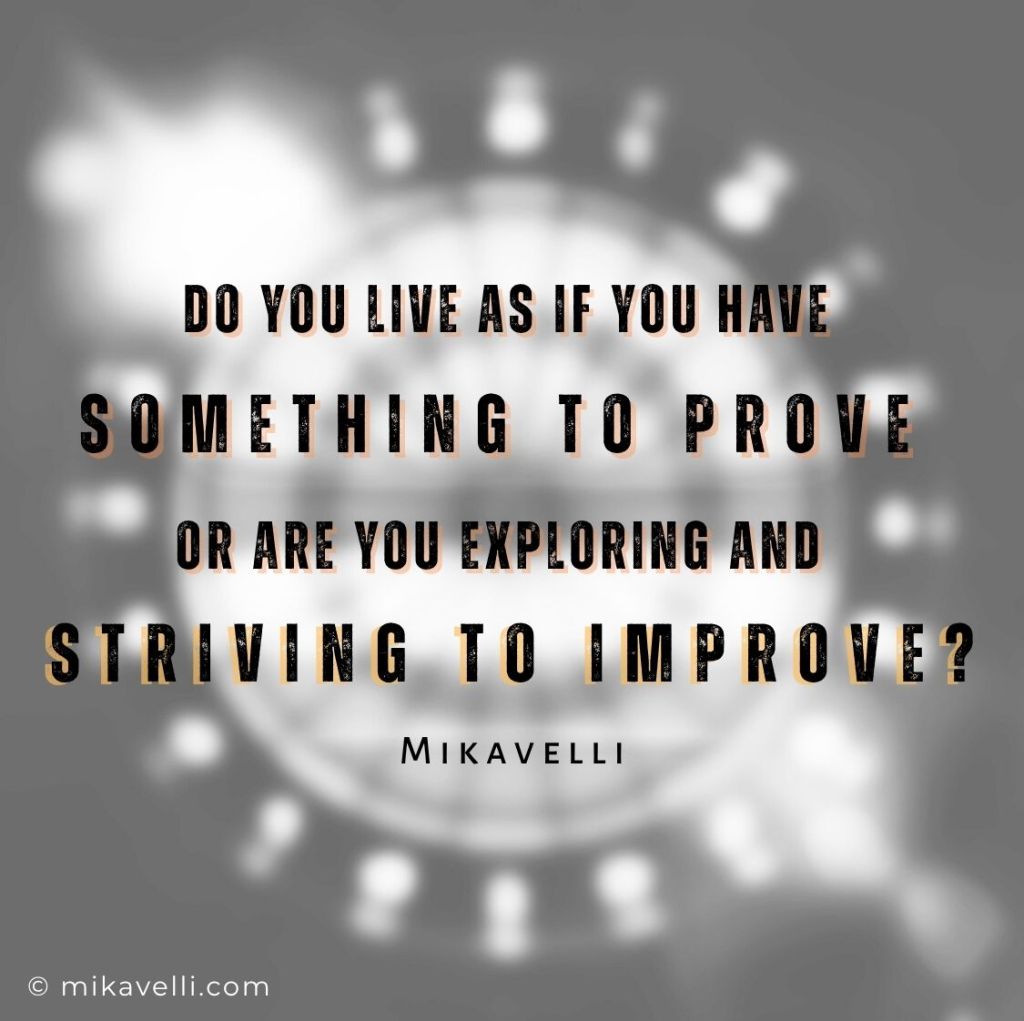
Do you live as if you have something to prove ,
or are you exploring and seeking ways to improve?
-Mikavelli-
As we progress in life, our preferences and perceptions change (hopefully for the better). We find ourselves with choices — to be or not to be, to do or not to do, to return or to progress, to stagnate or to expand. Once we make those choices, our decisions thereafter inevitably follow and either contribute to our development in multiple aspects, or perpetuate a spiral of sabotaging our progress. But life is not linear and these changes often come with trial and error, but improvement does occur when we train our self-discipline to make sustainable (but also fun) choices. Much of this pertains to mindset and attitude.
People with a fixed mindset make choices that are predetermined by a fixed ego and perception of status or reputation (e.g. ranking, society, relationships, status etc). Those with fixed mindsets stay in that loop because it serves as a comfort zone, limited to knowledge that becomes a definition or label of how one ‘should’ be. It could mean adhering to specific norms and titles, altering (or ‘masking’) behaviour according to expectation and demand, and caving under the pressure to ‘play a role’ so as to fit into those ideals. The hubris of a fixed mindset entails an idealism where one assumes the knowledge and experience they have acquired is the ‘be all end all’ of who and what they are to become, and leaves little room for new perspectives or improvements. To some extent, this can be seen as a self-fulfilling prophecy where the person complies with whichever stereotypes govern the drive and perpetuate a compulsion towards ‘outcomes based’ results, then decisions are made according to the perceived norm and expectation.
To some, the fixed mindset becomes a comfort zone — the fear of change, the stubbornness of doing the same thing the same way repeatedly yet expecting different results, the notion that one is defined by labels and measured by external ‘value’. On the one hand, this means less thinking and more doing, and rather than learning from trial-and-error, they may avoid taking risks because they want a predictable outcome.
On the other hand, the growth mindset involves open-mindedness and a willingness to venture on adventures (literal and/or figurative). When we have a growth mindset, we base our decisions on choices that propel us in a direction of expansion, change, and transformation. This mindset entails differentiating between ego and experience — the contrast of whether a choice is made based on ideals (ego) or on acquired knowledge and reflection (experience). Overcoming this, however, is also a matter of choice — to progress from a fixed mindset into a growth mindset is a choice of its own, too. Each person has an individual starting point in life contextual to their reality. Some begin in a state of preconceived notions and preexisting conditions, and make the choice to fixate themselves into such a state; some begin with the opportunity to explore with curiosity and have access to various perspectives, personalities, and people. These external factors influence or impact us, and our decisions then reflect who we are or becoming.
To some, these changes occur naturally such as adapting to aging, health or environmental factors, entering a new industry with new routines. We give ourselves time and space to adapt accordingly and these new habits inadvertently become a lifestyle. The challenge is to make consistent progress within the routine and not become overly rigid that leads to stagnation. Along the way, we make conscious changes such as physical presentation, living situations, and learning to navigate dynamics and maintain friendships or relationships. While we might retain aspects of our core values and general ethics in life, we also allow ourselves a chance to expand horizons, embrace new perspectives, and accept that our previous understanding and interpretations of events or experiences may also grow or deepen.
At this stage for me, I generally try to maintain a growth mindset in scenarios or dynamics — whether it’s at work, in social and interpersonal settings, and with myself (like hobbies and learning new skills etc.) That said though, I do acknowledge that there were times in my younger years (more so in school and first job) where the fixed mindset was required of me because of context. However, I took it on as a ‘growth challenge’ to try and adapt to an environment where I was surrounded by people who expected us to adhere to their fixed ideals imposed upon us. It wasn’t easy but I saw it as an opportunity to learn — with the irony being that I became stubbornly fixed on growth and basically ended up in the same mindset as them, just with different ideals… It wasn’t until I left those environments that I could focus on actual development rather than fixate on trying to prove ‘growth’.
“…there is no binary to mindsets as we are malleable fluid embodiments of
our perceptions, beliefs, lifestyles, and experiences.”
Although there are (some) self-help ‘authors’ out there with cliche best-sellers who might dichtomise mindsets into either-or (as in either fixed or growth), I do share from my own experiences at least, that there is no binary to mindsets and we are malleable fluid embodiments of our perceptions, beliefs, lifestyles, and experiences. At different stages and places in life, we might find ourselves intersecting between mindsets, or even generating a whole new way of thinking entirely if such is required. Essentially, the willingness to learn from mistakes is more lasting than the exhaustive attempts at faking perfection.
So with all that said, do you think mindsets are defined, or does the experience of ‘fluctuating’ between headspaces resonate with you? Feel free to drop a comment or send a message if you’d like to connect.
Thanks for reading and wishing y’all an inspiring day!
Mikavelli
(Originally written in April 2024 — Life after Survival: Strive and Revive)
References
1. Psychology Today: Growth Mindset — “A growth mindset is the belief that a person’s capacities and talents can be improved over time.”
2. The Decision Lab: Fixed Mindset — “A fixed mindset is the belief that abilities are innate and unchangeable. This perspective leads individuals to view success or failure as a reflection of inherent proficiency, often limiting personal growth.”
3. Carol S Dweck: Mindset (Book) — “No matter what your ability is, effort is what ignites that ability and turns it into accomplishment.”


![in need of change — [Poem]](https://mikavelli.com/wp-content/uploads/2020/06/humanity.jpg?w=960)


Leave a Reply